
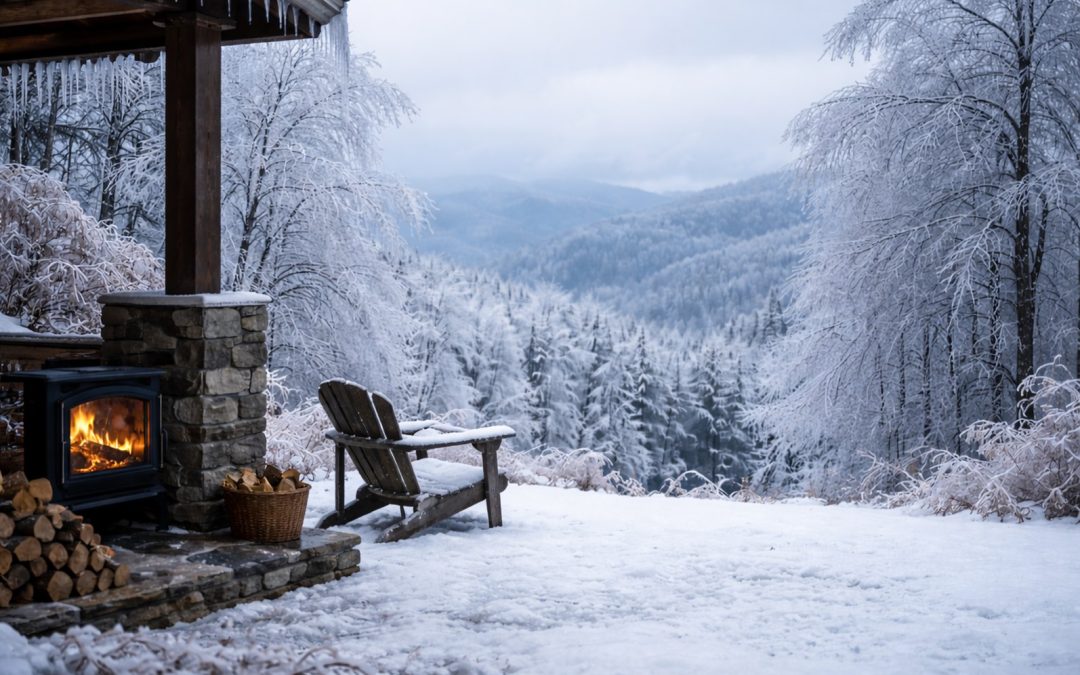
Ice storms are one of those weather events that don’t always sound serious – until you experience them in the mountains.
In the Blue Ridge Mountains of Western North Carolina, ice storms often cause more disruption than heavy snow. Freezing rain coats trees, power lines, and roads with a thick layer of ice, leading to downed limbs, power outages, and dangerous travel conditions – especially in rural areas.
This recent storm (although not as crippling as predicted) was a reminder of just how quickly things can change here. We lost power for a day and a half, and while that’s not unusual for mountain living, it’s always an experience that forces you to slow down and adjust.

What Ice Storms Look Like in the Blue Ridge Mountains
Since moving to the mountains, we have learned typical ice storms don’t usually arrive with drama. At first, it looks peaceful-trees lightly coated, and the ground is shimmering.
But ice is heavy. As freezing rain continues, branches bend under the weight. You start hearing sharp cracks echo through the woods and limbs break and fall. Roads become slick before there’s any visible accumulation, making steep driveways and narrow mountain roads especially dangerous.
This is the part many people don’t expect. Ice doesn’t pile up like snow – it clings to everything. Every grass blade, every tree branch, the cars, power lines, street signs, houses…everything!
Before this sounds too dramatic, let me clarify, although the ice and snow storm put our small mountain town on pause for a day to two, our area DID NOT get the worst of it. Some were without power while others nearby went on living as usual.

Losing Power During an Ice Storm in the Mountains
For days, the news anchors were telling us to be prepared for catastrophic ice and to be without power for up to a week. After experiencing Hurricane Helene, we took every warning serious.
Power outages are common during ice storms in Western North Carolina, especially in wooded areas where falling trees and branches take down lines. Living in the mountains means learning to shift your mindset quickly – we go from convenience to basics of survival.
Without power, the house grows quieter. The days and nights feel longer. You become aware of slight temperature changes, and are quickly reminded of how much electricity quietly supports our daily life. Thankfully, during this weather event (Fern), we only went without power for under 2 days. During Helene, we went nearly 10 days.
Let’s first give credit where credit is due… THANK YOU to all of the lineman who spent long cold days restoring our power! We appreciate you and hope you enjoyed your hot coffee and rice krispie treats! (Please offer them something hot and perhaps a snack…they’ve been in the cold hours on end)

Due to the ice causing downed power lines and trees, we lost power early Sunday afternoon. When the power went out, we knew it could be a while. This is why we take Winter weather prepping serious.
Thankfully, we prep our home throughout the year, but had specific winter weather preparations in place. With a tri-fuel generator that was able to run our furnace, we comfortably beat the negative windchills!

How We Prepped for a Winter Storm
If you’ve been around to hear our story about Hurricane Helene, you know we prep our home throughout the year. Never wait until it’s too late!
Every power outage teachers you what actually matters. And, every long-term power outage – depending on the season – teaches you ways you can prep even more than you planned.
During this Winter Storm, a few things made a noticeable difference:
✔️ A reliable backup heat source (the generator ran our furnace & heat pump)
✔️ Simple food options that didn’t require much prep
✔️ Extra fuel to keep the generator running
✔️ STARLINK to have back-up wi-fi. (It has a built-in heating element to keep ice from forming on it)

While many question the need for Starlink Internet devices, this was an investment well worth it to us.
Living in the mountains, cell service is spotty and gets knocked out easily. Without cell service, the only way we can call out is through wi-fi calling. Starlink, on the other hand, allows us to stay connected.
One thing to note, your Starlink runs off of electricity. Therefore, in the event of power loss, you will need to run it from your generator or power bank. It is so easy to set up yet gives such a big piece of mind.
You don’t need to be over-prepared, but having a basic plan makes a stressful situation much more manageable.
What We’ll Do Differently Next Time
Although the storm was not as bad as predicted, even short outages highlight small gaps in prepping.
Specific to prepping for an ice storm, we would like to invest in a wood burning stove. Here in the south, there are no building codes that support such freezing temperatures. Therefore, many homes risk pipe damage and possible foundation issues when faced with heavy ice.
Although a generator kept our furnace and heat pump working, we would like to install a wood burning stove in the basement of our home to protect the pipes. Plus, if we were to run out of fuel for the generator, the heat from a wood burner would rise and keep the house warm.
If you have a wood burning stove, and would like to share your input, please leave a comment at the end of this post.


Why Ice Storms are Often Worse Than Snow in the Mountains
Snowstorms may be more visible, but ice storms tend to cause more damage in the Blue Ridge Mountains.
Here’s why:
- Ice adds extreme weight to trees, increasing breakage
- Power lines are more likely to be pulled down
- Narrow, winding roads ice over quickly
- Restoration takes longer due to steep terrain and dense woods
For mountain communities, ice storms are often the most disruptive winter weather events.

How Long Power Outages Can Last During Ice Storms
One of the biggest questions people ask is how long outages last.
In mountain areas of Western North Carolina, power outages during ice storms can range from a few hours to several days, depending on damage and accessibility. Crews often have to clear fallen trees before repairs can even begin.
That’s why preparation—especially for heat and communication—is so important.

The Reality of Winter Life in the Blue Ridge Mountains
Living in the Blue Ridge Mountains means accepting that winter weather sometimes takes control. Power outages happen. Roads close. Plans change.
But there’s also something grounding about it—slowing down, adapting, and settling into a simpler rhythm until things return to normal. Ice storms aren’t just weather events here. They’re part of mountain life in Western North Carolina.

